


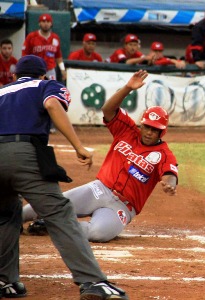
It does not take very much to penetrate into the principal elements of the story that not long ago over one week the reporter Enrique Rojas threw to the hem, of the ESPN channel. Briefly, official investigations would have detected the use of several false passports on the part of the player of Granma.
These documents were corresponding to the Dominican Republic and they would have been used to overcome the obstacles that the American blockade imposes against Cuba. The Helms-Burton and Torricelli laws explicitly prohibit any commercial exchange between institutions and natural persons of the United States and the island of the Caribbean. The same prohibition spreads the subsidies and companies established in other countries.
Such is the situation in which there is the Mexican League of Baseball (LMB), the tournament where the Pirates of Campeche compete, the team to which for the second year in a row Despaigne had joined.
Already in the past campaign another two Cubans had accompanied him in the experience: Michel Enríquez from Pinar del Río and Yordanis Samón from Granma. Among all there had stood out the so-called "Horse of the horses", who in his début in Aztec grounds went so far as to equal the hits record for a party (6), that for several decades was remaining in exclusive power of his compatriot Martín Dihigo and of the local idol Daniel Fernández.
Performances like that of that day, when he scored 6-6, and those of the present tournament made him deserve the appellative of "El Triturador", with which he is met in the summer circuit of Mexico.
Everything seemed that now it would be the same, and that his outcomes would open the door for new incorporations of native athletes to this contest with Triple A category and subordinate to the American professional system.
There was precisely the obstacle, apparently someone tried to overcome by means of false identity documents. The conflict was clear: with his residence in Cuba, Despaigne might not earn any money for playing in Mexico, the laws of the Blockade prevent it of explicit form. Maybe there arose the solution that now provokes the scandal.
Did the things happen this way or of another form or everything has been an "operation" fiddled to prevent possible future contracts?
If there are born in mind the declarations of the board of the Pirates, of the Cuban Federation of Baseball (FCB) or of the proper Despaigne, none of them is responsible. But neither I believe completely believable that it is a question of a groundless conspiracy constructed completely in the air.
Although to thousands of kilometers of the facts and without the possibility of judging the majority of the elements in game, it seems clear that in this opportunity the error was not judging all the legal difficulties that might cause the linking with a professional league, subordinate to the structure of this sport in the United States.
Who had to do it? The National Institute of Sports, Physical Education and Recreation (INDER), and of course, the FCB. But they did not do it.
Very possibly the case of Alfredo Despaigne does not have major consequences from the legal point of view, but the "sports" damage is already done. In the nearby future nor he nor other resident players in the island will be able to play in selections of the LMB, at least not while they do not leave their country and establish in any other nation of the Caribbean.
The most recent example that the Blockade does exists, is this one. Fortunately or unfortunately its victim has been the sport that most of the Cubans like.
Translated by BA in English Language, Manuel Barrera Téllez
{flike} {plusone} {ttweet}