


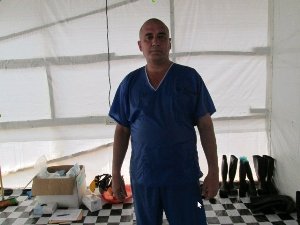
I do not know him personally, but I give faith of his extreme simplicity and spirit of solidarity, like others with which I have already contacted: it seemed like an incurable virus that go in the blood of Cuban physicians and nurses dedicated to that one and other missions in the world.
- How does the epidemic behave?
- Although there are active foci, the contagion rhythm is much minor; earlier we saw 20 daily cases and now just three and four, and some days none. Among the sources of infection we find the clandestine burials, frequent in the rural areas, like this one.
- How is your familiar composition?
- I have a beautiful family. My wife, Diarelys García Díaz, Bachelor of Infirmary, works at the same hospital as I in Camagüey; we have three children: 18-year-old José, first year student of Medicine in the University Carlos J. Finlay; Claudia, of 17, in the last year of the Vocational Pre-University Institute of Exact Sciences (IPVCE) Máximo Gómez Báez; and 14-year-old Joel, that studies the ninth grade in the basic secondary school Juan Marinello, all in Camagüey. We live in the Padre Valencia street.
“Also, there are my parents Norma and Asdrúbal, the responsible for my formation. They are paradigms in my life. She works at the General Secretariat and he is a Doctor of Sciences and Tenure of the department of Mechanics of the faculty of Electromechanical Engineering, both of the University of Camagüey”.
- How did they welcome your determination of going towards this place?
- The first thing was the surprise, then something like consternation. We all knew the risk. The morbidity and the deadliness of this epidemic are very high. After this feeling there came the logical reasoning and the opportune conversation with my children, my wife and my parents about the need of preventing, first of all, this catastrophe of coming to Cuba with its step that would be devastating.
- What did you think on having been nominated, like part of the brigade Henry Reeve, for the Nobel Prize of the Peace?
- I cannot deny it, I felt an immense happiness, it was an international gratitude that recognized before the world the brilliant idea of the Historical Leader Cuban Revolution Fidel Castro, creator of the contingent.
- Tell me how a working day is.
- The motel, like almost the whole country, has no electric power. We are provided with a small generator that only works from 7:00pm to 7:00am, hour in which I get up, have breakfast, and 30 minutes later I go out in a bus towards the hospital, to approximately three kilometers more or less. On having arrived, I go to the place of the delivery of guard, where are we, the North Americans and the national nurses; hence I go on to the rest area and I dress with the suit of personal protection. We always do it in duo, never alone.
“No part of the body can stay out of the protective suit because it might be fatal, that's why we are dressing ourselves and checking one to another not to make errors. All this part of the hospital is the green space with a minimal risk, at least theoretically. Later, and previous orientation in the guard delivery, I move myself up to the red area, that of major danger, and where the hospitalization rooms are. In there I do everything, like the others, feeding the patients, bathing them, cleaning their secretions, etc. Until now and with the God's help and the care that we put, we are going out victorious.
“The heat is unbearable, we sweat very much. On having wraped up, I go out towards the area where I undress. There is the biggest danger, an error in this moment costs the life, because you come from touching the patients and to be in contact with their fluids; the undressed moment, like the dressing, is supervised by the other and we look after and warn of any detail. Everything under the technique that we learned in the training we received in Cuba and here. Then I go to the area of rest where I hydrate myself. This mechanism is daily, from 8:00 am to 2:00 pm, and from 2:00 pm to 8:00 pm”.
- Tell me how a day of rest is.
- Very boring. I get up in the morning at the same hour, have breakfast, remain in the motel, we converse, others write in the laptop, or I wash some dirty clothes … it is very difficult to be in the room because in Africa there is a lot of heat and on not having had electric power it increases. Like that I am until the hour of lunch, go to bed to rest a little bit, then I bathe, eat; later, when they turn on the electricity I contact the family, send and receive mails, until bedtime.
- To your way of seeing: how much have you contributed to the decrease of cases of this hemorrhagic fever?
- To be sincere, as for the prophylaxis and handling in the community we could not have done any work; the work is concentrated in treating the patients who come to the hospital, already with ebola or with other ailment. The majority did it to five or seven days of being ill, already with the virus spread, but we manage to fight it.
- How profitable has been for you this experience?
- Very positive from the personal and professional point of view. I have learned, first of all, to value sincerely the Health System in Cuba. It is necessary to be here to realize what we have, although sometimes, we do not appreciate it. It is something incomparable. This is my second mission, and in Venezuela, even with the Cuban help, the soundness of its system of Health is distant from ours.
“There is no community projection, therefore the epidemic cannot be controlled completely because it is not fought in the community.
“A big number of them have tuberculosis, aids, malaria …, all without medical treatment and without follow-up care for some professional. From the personal point of view, I agree with the vision that the direction of the Cuban Revolution had that only men were coming here. It had been terrible for the mothers of our country to see and to live here.
- How is the relation with the professionals from other nations?
- They are magnificent. I am in the hospital Maforki New, with a Nongovernmental organization, International Humanitarian Partner Ship (IHP), from North America, with whom I work every day, along with national nurses.
- Do you notice gratitude or indifference of the locals?
- The gratitude is palpable to our step along the communities, on having moved us in the bus from or towards the hospital.
- What would you say to your companions in Cuba?
- I know that this barrier would have been penetrated by any of them because they are prepared. We do the best possible thing to put in high place the name of the homeland, first of all; and of the Cuban Medicine, in second, and notice, not only the Cuban, also the Latin American in general. This way said to us a representative of the World Health Organization (WHO), a Mexican who visited Sierra Leone, who said: "I am satisfied because you represent the whole Latin America”.
- Have you felt fear?
- Every day. I am not ashamed of it. When you stop feeling it you are careless and you make errors. On having entered the red area, it is as if the death was waiting for you and you have to look after and evade it. The fear is a reflex that keeps me alive.
Translated by BA in English Language, Manuel Barrera Téllez
{flike} {plusone} {ttweet}