


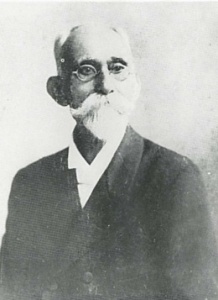
This man, who was born in Baní, Dominican Republic in 1836, came to Cuba almost thirty years later, and right after his arrival he was already part of the conspiratorial activities. Some days after the military rebelion on October 10th in La Demajagua, he was admitted into the rebellious lines with the sergeant rank. On November 4th of that year, in the place known as Pinos de Baire, in Oriente province, he commanded the first machete charge of our heroic deed, against a military column of more than 700 Spanish soldiers.
The Camagüeyan had the honor that, after the irreparable loss of our Ignacio Agramonte in 1873, Gómez assumed the control of our forces, to continue the glories route.
During the Ten Years War, on his excelent records are, the Guantánamo and Camagüey campaigns, the Invasion to Las Villas; Las Guásimas, La Sacra, Palo Seco, San Miguel de Nuevitas and Cascorro victories, among others.
Gómez was a brilliant strategist, according to researchers, with young pupils and inexpert soldiers who became commanders of universal reputation, like Antonio Maceo.
Actually, his greatest enemy, the Spanish Commander Arsenio Martínez Campos, called him the first guerrilla of America. So important he was.
During the period known as Fruitful Truce, Gómez always dreamed of the rebeginning of the war, until, summoned by José Martí for the new conflict, he played a decisive role in the union of the patriots in the Cuban Revolutionary Party.
For these reasons he signs, along the Martí, the Manifesto of Montecristi, on March 25th, 1895, and then he entered the country through Playitas on April 11th and joined the fight.
As an army man, he took advantage of everything, not only of the abstinence, the resistance, the value, obstinate and stoic, of the mambises, but also of the soul of his enemies, the mosquito, the brackish pond, the epidemics... noone like him knew better the war and made vibrate the most intimate fibres of his men, what gave him the possibility of making miracles.
Máximo Gómez hated the slavery and the racial discrimination; he was a model of father; symbol of the solidarity among the peoples, and with his convictions and energy he promised that while he was breathing he would not rest up to concluding the initialized work.
Betrayed by Tomás Estrada Palma, president of the Republic of Cuba on May 20th, 1902 under the North American intervention, with more than sixty years of intense life, Gómez tried to return to the fight knowing he already had not the energy to.
When he died, like the humblest of the patriots, he had had the supreme gesture of resigning from the presidency of the Republic. While describing that day, Pedro Enríquez Ureña said: "The entire city was in mourning, the burial was to be at 3:00 pm of Tuesday, June 20th. To define what was a declaration of official and popular mourning there is only one adjective: Colossal!
"The people rioted several times and the police suppressed them; they wanted to take the coffin out of that harmonious official courtship and to carry it on their shoulders to the cemetery..."
There remain in the memory and in the heart of generations of Cuban the deepest traces of respect, love and gratitude for he who came to Cuba knowing that "(...) foreigner as I am, I have not come to serve to this people, helping it to defend its cause of justice as a mercenary soldier... but like a soldier of the people".
Translated by Ariel Ballester (Student of Languages)
{flike} {plusone} {ttweet}