


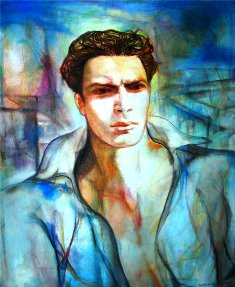
Nicanor's life, identical name to that of the dad, (but called Lamy for everubody) and his younger brother, Cecilio, was bearable even over their legal nonexistence, unusual fact inside the social conventions of the small bourgeoisie of the professional business of Cuba to beginnings of the XXth century.
The parents took without blushes that adulterine life, which for then was reinforcing the popular image of the successful manliness. They inscribed Nicanor at the age of seven and with the maternal surnames, since for 1910 the crisis of the couple turned irreversible and along with the rupture it was necessary to solve the legality of the children. Inheriting the surname of the father would bring too many complications.
Cecilia left Cuba for the United States leaving to Don Nicanor the children. Some time later, he married, had other children and turned into a continuous absence for his first progeny, who happened to reside in the paternal house, and as bastards they endured even the lost of their names. The stepmother, devotee to San Antonio of Padua, called Nicanor as Antonio, and his brother, Nicasio.
Influence by Mercedes he was in the school of the Padres Escolapios de Guanabacoa, but violating the discipline of the schedule of the night study, attacking the priest who was scolding him and throwing a stone against the principal door on having left the school, not only cost him this expulsion, but the reputation not to be registered in any other catholic center.
Such is his bravery that in the short period that was with his mother in New Orleans enlisted in the army, ensuring to have over 14 years.
A friend of his father managed to take him out of the Navy and return him to Cuba, where he registered in the Newton Academy. There his teacher was the Mexican poet Salvador Díaz Mirón, who inculcated him a tremendous taste for the reading and the love of writing, future weapon.
Pero Nicanor wanted, like his grandfather, to be a military.
Pero la Mexican Law was prohibiting the foreigners to serve in the army in peace times. From these adventures he takes the pleasure for the adventure, and also from Mexico brings his new alias: Julio. Yes, he would be Julio Antonio Mella.
They would not call him like that since the studies in the Institute of the Second Education of Pinar del Río, but soon this name would be popular in the faculty of Laws of the University of Havana. Since 1921, there were taking place student manifestations so that the cloister was attending their claims.
Under the baton of Zayas the university students would not find but effervescence. There enters, of course, Julio Antonio, pinched also in finding a new fiancée, since Silvia had gone away definitely for Santa Clara. To it he would be helped by his sports form, an image that was favoring.
He organized secretly the brotherhood of the Manicatos, from which there would go out the leaders of the future University Student Federation (FEU), of which he was elected General Secretary for one year. He promoted the magazine Alma mater, where he repeated the anti-imperialistic criticism of the actions of the United States and its Pan-Americanism. He devoured books of Martí and Lenin.
In 1923 he leads the struggle for the university reform. Since then he headed the exhausting negotiations to link the university students with the boys of the institutes of the second education, the normal schools and the private schools (religious and lay) in six provinces. Not in vain in October of this year, in the First National Congress of Students, organized and directed by him, they choose him president of the event.
He does not rest. In November he sets up the Popular University José Martí, in order to instruct politics and knowledge to the workpeople, and of linking the University “with the needs of the oppressed ones”. In his works the feminine love already boosts him again. It is a question of the Camagüeyan Olivia Zaldívar Freyre, to whom he marries in 1924.
He was the principal maker of the project of the Students' Confederacy of Cuba, which accelerated the irruption of the adolescents in the political, social and cultural life of the country. If this was one of the most original contributions of Mella to the revolutionary student movement of Latin America, what to say about the foundation of the first Communist Party of Cuba, along with Carlos Baliño. He was expeled from the university. His energetic hunger strike, nevertheless, was always present.
On the following year, Mexico. He takes Olivia with six months of pregnancy. Their economy so precarious that when the baby was born, already dead, they had to deposit the corpse in a carton, unable to finance a burial.
Together they overcame the sadness. Mella and Olivia fought together until in October, 1927 the situation for the upbringing of the second daughter, Natasha, born in August, became untenable in the small apartment where they were living. Olivia returned to Cuba.
Mella was still feverish in the struggle. Linked to the continental revolutionary movement, he used again the letters as weapons in the newspapers Cuba Libre, El Libertador, Tren Blindado, El Machete and Boletín del Torcedor (the last one of Havana). He delivered lectures, published critics on the Mexican muralism, but concentrated his strengths in favoring the proletariat. He was present at the World Congress against the colonial oppression and the imperialism celebrated in Brussels. He traveled to Moscow to the Congress of the International Red Trade Union. Member of the Central Committee of the Communist Party of Mexico, founded several anti-imperialistic, student and rural organizations; fought for the agrarian reform, for the nationalization of the oil and in the strikes of the miners.
Of course, he never forgot his homeland. With Leonardo Fernández Sánchez and Alejandro Barreiro he organized the Association of the New Cuban Revolutionary Emigrants.
Of his devotees the famous one is the Italian photographer Tina Modotti, with whom he flirted four months, until was produced one of the most overwhelming political murders of the XXth century in America.
On January 10th, 1929, with only 26 years of age, Julio Antonio Mella fell down. An agent of Machado planned the crime with two paid assassins. But not even that erased the trace of that man. On the contrary, since his childhood, Nicanor chose the good glory, that of his grandfather, and achieved it without any notch.
Translated by BA in English Language, Manuel Barrera Téllez
{flike} {plusone} {ttweet}