


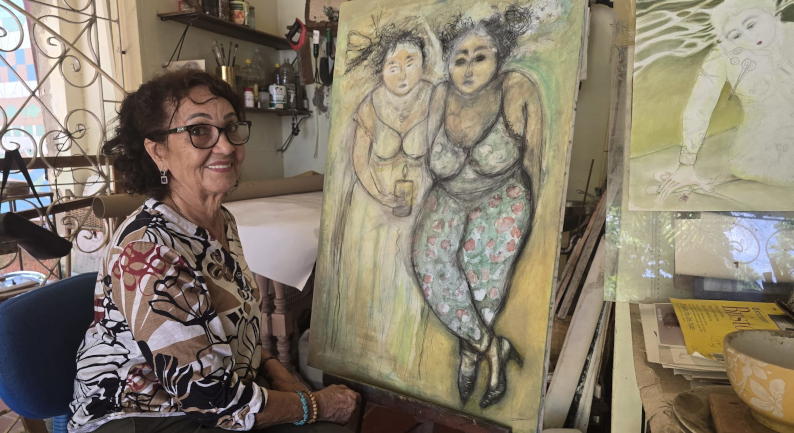
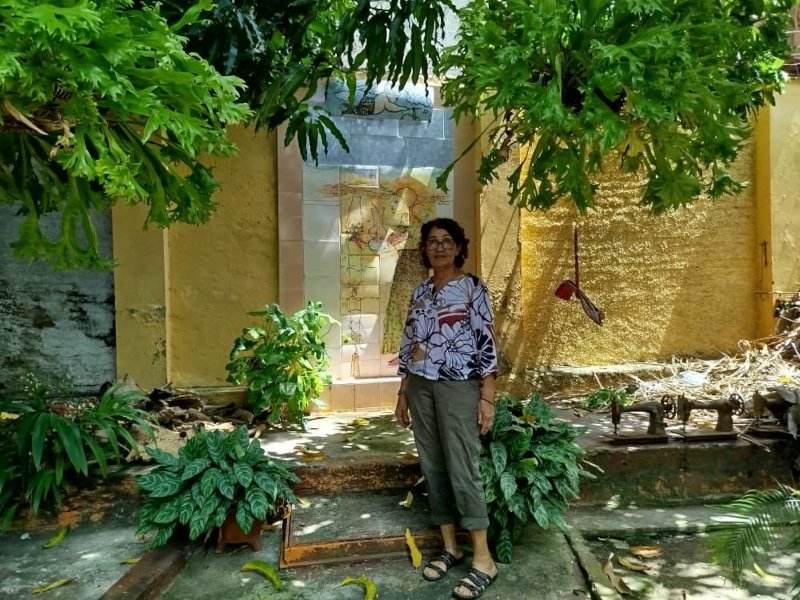
CAMAGÜEY.— From the entrance of the house, your eyes travel across the courtyard. First they find the vegetation: leaves opening overhead, plants filling the corners, shadows shifting with the light. Then, almost at the very back, a woman appears.
She is painted on one of the walls at the far end, like a presence that does not reveal itself all at once. You have to move closer to discover her. That is when the house begins to resemble the woman who lives there: something revealed layer by layer, among plants, memories, old objects, and works of art still waiting for their moment.
I am at Martha Jiménez’s home, in one of the galleries in her courtyard, near the entrance to her studio. We talk while a life that seems carefully assembled unfolds around us, although she insists that many of these things simply found their way there over time.
Halfway through our conversation, we drink juice made from white guavas picked right there in the yard. Natural, with no added sugar. Sweet and refreshing. Martha talks and I look around: the pomegranate tree, the sewing machines, the chickens, the plants, the artworks. And I think there may be no better place to talk with an artist whose work also seems to have grown out of learning how to look.
“Observation gives you everything,” she will tell me later.
THE NEWS
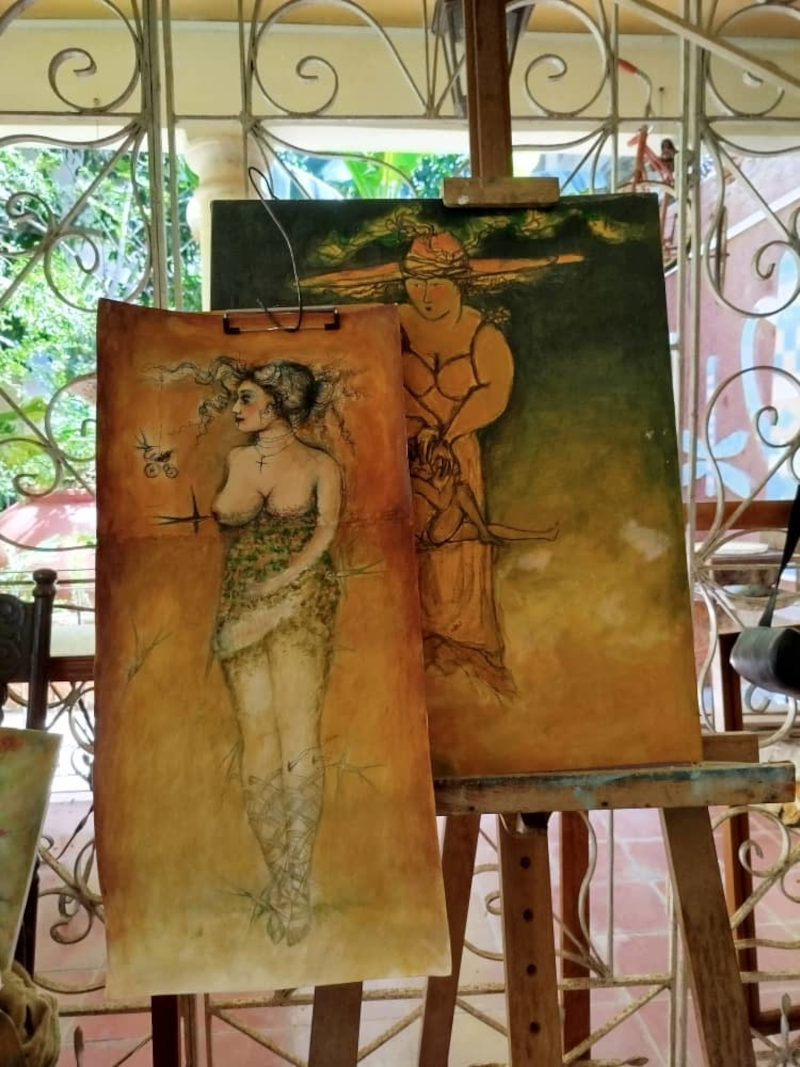
Our conversation begins with news that seems almost too big for that courtyard: Martha Jiménez has once again been selected to participate in Art Basel, one of the world’s most important art fairs, in its 2026 edition.
She tells me about it with a mixture of surprise and a sense of responsibility.
“The first time I got the news, I was surprised because taking part in an event like that… Well, sometimes I go somewhere and I don’t really know. When I participate, I say, ‘Wait, where am I?’ That’s just the way I am.”
Now she knows exactly where she is. And she also knows what she has to do. The fair will take place in December. She will present miniature murals and sculpture, the latter still in progress. She submitted it as a project, and now she has to turn it into a finished work.
“I have to work very hard for it because the fair is in December, but I’m grounded and ready to work.”
The sentence may sound simple. But behind it is a woman who knows what it means to produce art from Cuba, with all the limitations, delays, difficulties, and even the heat of these days. She herself laughs when remembering that she is sometimes surprised by what she has accomplished.
Not long ago, she was looking back through the awards she has received over the course of her career when she came across one that said “Continental Prize.” A Continental Prize? she wondered. Then she stopped to consider the weight of that word.
“I never really take in what happens to me or what I’ve done.”
Perhaps that is one of Martha’s most endearing qualities: the distance between the magnitude of her career and the natural way she speaks about it. She does not seem to speak from the pedestal of awards, but from the studio. From the work.
A LIFE MADE OF STAGES
There have been many Marthas within Martha. There was a time when she fell in love with working with children.
“I adore children,” she says.
She wanted to create things with them and eventually took part in international events in countries such as Czechoslovakia and Poland, where she received recognition for that work.
Before that, she had worked with older adults. She brought together adults—including doctors and other professionals—who had once dreamed of painting a picture and helped them reach the point of holding solo exhibitions.
“It was very interesting work with adults, and it was deeply rewarding.”
One of her own phrases explains why she remembers that experience so clearly:
“Even if there wasn’t an award of another kind, there was a recognition in those people that they would never forget.”
Then came the stage of being both a mother and an artist. Her three children grew up watching her work. She often did so at night or in the early hours of the morning.
At the same time, she carried food to the University of Havana in boxes meant to last the entire month, traveling between Vedado and Cujae.
“I think I had a great deal of physical and mental strength, and I achieved what they wanted me to achieve. It was very difficult.”
She says it without drama, like someone remembering a time when everything simply had to be done.
Her children did not become artists like her. But art somehow remained part of the family. According to Martha, her son has an extraordinary knowledge of art theory and a remarkable ability to appreciate music, cinema, and different forms of artistic expression. The others found their own paths.
“Because I worked so much with children, I put them all in the group, and they won awards.”
Now she also looks toward the next generation. She has watched her great-granddaughter work and believes she has talent. She speaks about children and about one of the first things she believes they need to learn: how to occupy space.
She recalls a psychological principle related to the size of figures in children's drawings. When a child makes the figures larger, she says, it may suggest that the child feels the spiritual needs of the home are being met; when everything is drawn very small, it deserves attention.
“You have to teach them that they need to occupy space.”
For Martha, art is not simply about training artists.
“It’s not that the child is going to become a painter or a sculptor. They have to see it as a transformation of the human being, because art nourishes every part of life.”
CLAY AND CAMAGÜEY
Martha was not born in Camagüey, but the city has long been part of her biography. She came to work and stayed. One of the first things she discovered here was clay.
“It was wonderful.”
Working with it eventually became one of the defining decisions of her career, giving rise to what she considers the strongest body of work she has produced: ceramics.
That is why, whenever she traveled to events, she took the opportunity to talk about this land:
“Go to Camagüey. Camagüey’s clay is unique.”
There is something of that material in the story of her current home. It, too, has been shaped, adapted, and transformed. Her first studio was much smaller: the kitchen and a small section of the courtyard. But there was room enough for the work.
“You do it with a kind of love where you don’t feel the wall, you don’t hear the noise, you don’t feel anything.”
The spaces have changed since then, but not that need to create.
A COURTYARD FULL OF MEMORY
There are things in Martha’s courtyard that might seem random until she begins explaining where they came from.
There are the sewing machines that have become a symbol of her mother. Some people have given them to her because they know they will eventually find a place there. Old, rusty machines, frozen in time. Yet around Martha, they seem to be waiting for another chance: in her hands, something worn out can still have another life.
Beyond them is a small chicken coop, a rectangular space enclosed with wire mesh. Inside, a rooster, a hen, and a chick continue a family tradition.
“My mother always had roosters and hens, and I’ve always kept them in the courtyard.”
She does not raise them to eat them.
“I wouldn’t eat that stuff in a million years.”
She keeps them as a tradition. Just as she keeps the plants.
The yagruma tree. The coconut palms that now worry her daughter Tania because one of them could eventually fall on someone’s head. The vegetation she would like to bring even into the bedrooms and kitchen.
“There is nothing more nourishing, nothing that can give you more, than vegetation.”
She says she had that inclination from childhood. During school vacations, she would go to the countryside and, one way or another, learned to live alongside plants.
“It came from my mother,” her mother used to say.
But Martha immediately corrects the family tree: in fact, it came from her grandmother.
That is how her memory works: one thing leads to another. A plant leads to a grandmother. A sewing machine leads to her mother. A pomegranate leads to Eusebio Leal.
THE POMEGRANATE
The plant is there, close to us. Martha talks about Eusebio Leal and recalls a lecture he once gave about the pomegranate, about its importance. Later, she also learned the fruit’s legend from a church pastor.
She got her own plant. She planted it. She keeps it at home.
“For me, that person, where to place him, is present.”
She speaks of Eusebio as someone who allowed her to discover a world beyond herself:
“Meeting geniuses like him, from literature, connecting with them—it makes you understand life.”
Then she looks at the pomegranate tree and makes me a small, intimate, almost domestic promise:
“When I have one, I’ll dedicate it to you.”
A dedicated pomegranate.
There is something beautiful about that gesture. Perhaps because every conversation with Martha seems to become a form of exchange: someone gives her a story, a plant, a sewing machine, a lesson; she preserves it, transforms it, and one day gives something back.
LOOKING BEFORE CREATING
Martha is a quiet, observant person.
I tell her so.
Observation, she replies, is part of her life and a form of meditation. She remembers her great teachers and a rule she learned from them: observe for 15 minutes and work for five.
“In other words, the time spent observing was longer.”
The names of Sosabravo, Camel, and Mariano emerge as she recalls that lesson.
And once again she repeats:
“Observation gives you everything.”
Now I understand a little better the figure I saw at the back of the courtyard. From the entrance, she can barely be made out among the leaves. You have to move closer. Your eyes have to cross the garden, stop, search.
Like a work of art. Like a house. Like a person.
Martha then shows me the murals she wants to use to cover the courtyard walls. And the house begins to reveal another dimension: she herself has been shaping the space according to the way she sees.
It is not simply about living there. It is about building a world around a vision.
She says she feels almost as though she is living in a forest:
“Out there, nothing matters to me. I come in here and I can stay a month without going outside.”
She does not seem to mean it as confinement, but as refuge.
“I visualize everything, I feel everything, and I’m fine. Mentally and visually, everything helps me.”
WHAT STILL REMAINS TO BE DONE
There are unfinished works in the studio. A series about friends. Charcoal drawings. A series that began with scissors. And The Secret of My Goats, a work she loves because goats are also part of those particular obsessions that keep returning.
But many things are on hold.
Not because she lacks ideas. Because of time.
Travel, commitments, obligations, and now Art Basel force her to choose. So she has to change course and focus on the fair.
There is something almost circular about the scene: an artist who has devoted much of her life to looking now finds herself, in the midst of another international opportunity, having to set some works aside in order to finish others.
The woman who has turned courtyards, kitchens, clay, children, plants, animals, and memories into creative material is once again facing a deadline.
December. Art Basel. Work.
FAMILY AS A BEGINNING
Before we say goodbye, Martha talks about her parents.
Her father was a reader, a man whose intelligence she remembers especially well. He held an important position at a sugar mill, had studied to the level of a technical degree, and had traveled. Her mother was kind, calm, and a woman of few words.
It was her father who recognized something in her and helped guide that talent. At the entrance to the house, among the furniture where she keeps her trophies, sits the music box he gave her—a treasured possession she considers one of her greatest prizes, alongside a vase gifted to her by her teacher Sosabravo.
So when I ask what advice she would give at a time when people’s view of life so often gets trapped in everything negative, she does not begin by talking about art.
She talks about family.
“The most important thing I see in the world and in life is family. Family is the greatest thing.”
Then she returns to art, because for her the two seem inseparable.
She says art does not heal you the way an antibiotic does or take away pain, but it can transform the mind. Bringing children closer to art from the cradle can give them other opportunities. Each person is, to some extent, what their family allowed them to become.
And then she offers another of those sentences that seem simple until you hear them after learning a little about her story:
“To live for art—that’s what I hope for.”
BEFORE DECEMBER
When we say goodbye, the pomegranate tree is still there.
So are the sewing machines, the chickens, the other plants, and the works waiting for their turn.
Perhaps in a few months, one of the pieces now on hold will once again occupy the place Martha has reserved for it. Perhaps the woman at the back of the courtyard will find herself surrounded by new murals. Perhaps the pomegranate she promised to dedicate to me will finally ripen.
And in the meantime, in the house she has transformed according to her own way of seeing, Martha Jiménez is preparing for her return to Art Basel.
She does not seem overly concerned with the magnitude of the statement. She is concerned with working.
Because after a lifetime of awards, travels, children, clay, young people, older adults, exhibitions, and works of art, perhaps that old rule from her teachers still holds true:
Look carefully, and then create.
Martha looks.
And now she has until December to create.
Translated by Linet Acuña Quilez