


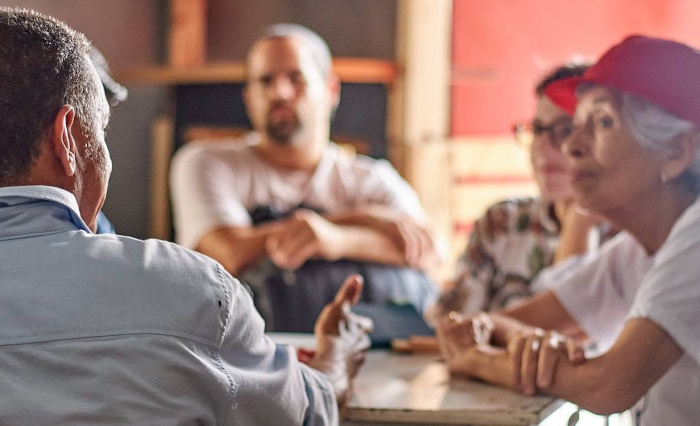
CAMAGÜEY.— I returned to the National Colloquium on Cultural Journalism. It has now reached its ninth edition. Inevitably, I found myself remembering the first one, back in 2018. A severe weather alert threatened to derail the event, but the participants came anyway. They crossed the country however they could to gather in Camagüey and talk about a profession that, then as now, was facing its own uncertainties.
Returning to the Colloquium also meant remembering those who helped shape it. Luis Álvarez Álvarez, who recently passed away, insisted that cultural journalists should be far more than conveyors of information. They should be “managers of thought”—people capable of providing context, offering interpretation, and equipping audiences with the tools to understand culture in all its complexity. José Aurelio Paz, meanwhile, championed a form of criticism willing to take risks, to engage with works honestly rather than complacently, and to resist what he called the “industry of stupefaction.” Together, they mapped out a path that continues to challenge us today.
It occurred to me that perhaps the greatest achievement of that gathering was not that it became a recurring event, but that it gave birth to a conversation.
A conversation that remains necessary.
The reflections shared this year by critic Juan Antonio García Borrero echoed some of the ideas recently explored by Kirvin Larios in his Notes on Criticism and Cultural Journalism. Though approaching the subject from different angles, both point toward a common concern: the shrinking space for criticism and for thoughtful reflection in an environment dominated by speed, fragmentation, and the relentless production of content.
Larios warns of the gradual disappearance of the critic in an era that increasingly privileges the “content creator.” He also recalls how cultural pages have steadily vanished from news outlets and how cultural supplements were among the first casualties of the crisis in print journalism. His observation feels especially relevant at a time when culture is often presented as entertainment—or as a respite from harsher news cycles—rather than as an essential lens through which society can be understood.
For his part, García Borrero emphasized an equally important idea: culture always exceeds the institutions that attempt to organize it. Cinema is far more than films; culture is far more than official programming. It exists in the margins, in processes, relationships, and everyday experiences that rarely make it onto visible agendas.
Yet the discussion surrounding cultural journalism in Cuba now faces an additional challenge. Before asking what kind of criticism we need or how we might recover public attention, we must first ask under what conditions journalism itself is being practiced.
The economic and energy crises have radically transformed newsroom routines. Shrinking resources, transportation difficulties, prolonged power outages, and technological limitations directly affect journalists’ ability to report, investigate, and follow cultural life across the country. Many events go uncovered not because they lack journalistic value, but because they have become materially inaccessible.
The consequences are twofold. Professional practice becomes increasingly precarious, while the representation of culture that reaches the public narrows. Part of cultural life remains visible within institutional circuits, while another significant portion disappears from the public narrative.
Which is why one of the most urgent questions today is not simply what kind of cultural journalism we want to produce, but what culture we are actually managing to tell—and what remains outside our field of vision.
In one of the passages cited by Larios, a line from writer Samanta Schweblin appears: “Paying attention is the greatest superpower.” Perhaps that still captures one of the fundamental tasks of cultural journalism: paying attention where others do not; slowing down when everything urges haste; creating spaces to understand what, even amid crisis, continues to define who we are.
That may be why some of the ideas José Aurelio proposed at that first Colloquium still resonate today: practicing criticism without fear of being wrong; refusing to be domesticated by technology or by bureaucratic visions of culture; uncovering the stories others overlook; and continuing to build, from the ruins and uncertainties of the present, that enduring edifice of the Cuban soul.
They are principles articulated years ago, yet they retain a striking and unsettling relevance.
Translated by Linet Acuña Quilez