


Perhaps the least valued, even among the students of her legacy, has 173 years of public diffusion and still waits for the vindication verdict.
The fact corresponds to two real slopes related to the science and diluted in Sab, its initial novel, the first one of abolitionist character in Spanish language, and that colonial authorities punished it by retaining it in 1844 in the Real Customs of Santiago de Cuba for considering it to be subversive and the opposite to the morality and the good customs.
The authoress introduced in the story, published primarily in 1841, in Madrid, references to archaeological elements of the northern Sierra de Cubitas, of approximately 60 kilometers of widening and major area of elevations in today Camagüey.
This is in the Cuban narrative the most ancient, and well-known allusion, to aboriginal pictography and caves, which are related to the leading personages: the mulatto slave Sab, in love with Carlota, the daughter of his proprietor; the Englishman Enrique Otway, fiancé of the young woman, and Teresa.
Based on an excursion, the topic tells about three cavities, but it centers the actions and the details on the one called Maria Teresa, with informations about the natural environment and the existence of paintings considered to be "... work of the Indians...".
The fragment is part of the X chapter and has over three pages in the Cuban edition realized in 1973, in the 100th anniversary of the death of the writer.
The story alludes, also, to the native Martina -one of the characters- and to a legend on an Indian chief.
An essay written by Mary Cruz qualifies the description linked to Maria Teresa like one of the most notable of the book.
About two year before the original publication of the novel, was spread the original scientific report related to Indo-Cubans pictorial testimonies.
The fact, of 1839, corresponds to the IX volume of the Memoirs of the Real Patriotic Society of Havana, magazine that was circulating in all the Hispanic possessions.
Later, and from Seville, where she was living, La Avellaneda requested in a letter to his uncle Manuel Arteaga taken root in Camagüey, a meticulous report of Sierra de Cubitas and its outskirts.
The importance of the paintings and of the cavity they did not remain just in the writings.
"Lost" to the effects of the researches in the science, since concrete indications of the place did not exist, the cave was found in 1974 after a trailing suggested by Eduardo Labrada, reporter of Adelante newspaper, and fervent promoter of groups of speleology.
In the underground enclosure 11 pictographic sets were detected, one of them with appearance of succession of zoological species.
Maria Teresa is today one of the protected places and of public visits in the ecological reservation Limones-Tuabaquey.
In a just demand, many advocate at present in the country the claim of the physical and intangible presence of the aboriginals in the Cuban culture -in its wide meaning of way of existence of the man-, and in population genetic factors.
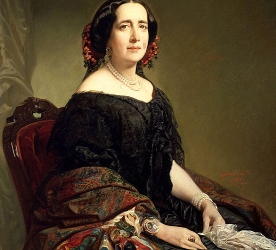
Gertrudis Gómez de Avellaneda forged, even if she had not done it of conscious form, one of these claims. And it is worthy to remember and to defend the real transcendency of that statement, especially in this 2014, year of the bicentenary of the birth of the one who was the principal feminine voice of the XIXth century in the Spanish letters.
Translated by BA in English Language, Manuel Barrera Téllez