
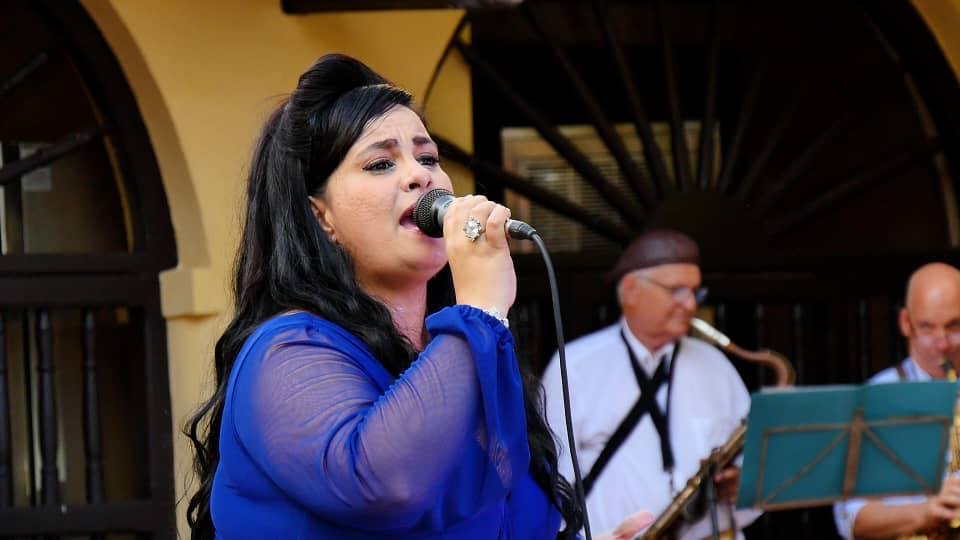
CAMAGÜEY. Evening settled gently over the courtyard of Hotel El Colonial by Mystique, setting the tone for a concert that invited listening rather than spectacle. In that intimate atmosphere, Yicel Acosta delivered a performance that became less a tour of repertoire and more a personal statement.
Over the course of just more than an hour—ten carefully curated songs plus an encore requested by the audience—the singer moved seamlessly through bolero, bachata, ballad-rock, salsa, son, funk, and merengue. It was not a scattered set, but a display of versatility supported by the group Mi Jazz, led by percussionist Yosbel Veloz, whose flexible and elegant sound anchored the journey.
Acosta is not an artist of long speeches. She introduces briefly and returns to the music—that is her center. Yet the silences between songs never feel distant; instead, they open space for emotionally charged interpretations. There were nerves—visible, human—and even tears, not as rupture but as part of an unfiltered delivery.
Five years ago, she spoke of her desire to navigate multiple genres, to reconcile her affinity for English-language music with Cuban roots, and to grow without adopting an imposed image. That aspiration, once in progress, found tangible form in this performance.
The repertoire confirmed it. Four songs in English coexisted naturally with the Spanish selections, revealing a phrasing closer to Anglo vocal traditions—elongated tones and carefully shaped words—without diluting her identity.
Among the most resonant moments was a duet with her daughter, María Isabel, performing Tell Him—a performance that transcended music into symbolism: continuity, inheritance, shared emotion. There were also meaningful exchanges with fellow artists, including Eduardo Cruz—whom she acknowledged as her first professional stage partner 25 years ago—in Si te cansaste de mí, as well as ensemble moments with John Márquez and Tania González, which added energy and camaraderie.
The program also made room for the standard The Look of Love and a rendition of Beautiful Things, the latter accompanied by a dance duo, where the visual element enhanced rather than overshadowed the music.
Beyond guest appearances and stylistic range, the concert found coherence in its intent: to present an artist no longer testing possibilities, but inhabiting them. The singer who once spoke of struggle and uncertainty now stands with a solid project—capable of integrating influences, sustaining a musical narrative, and, above all, trusting her own voice.
Acosta’s relationship with music is deeply rooted. She grew up in a family where sound was part of daily life: a grandfather who was a percussionist and backup vocalist, a father who played guitar and led groups, a mother who sang in a professional choir, and a sister inclined toward singing. That environment shaped not only her early exposure to the stage but also the organic sensitivity that defines her interpretations today.
Her path, however, was not linear. At one point, she trained as a mid-level technician in metrology—a detour that speaks to exploration, deviation, and return. Rather than contradicting her vocation, that experience reveals another layer of her trajectory: an artist who has built her place through personal decisions, even when they meant stepping away from music. That lived history now resonates onstage as part of an identity that feels authentic rather than constructed.
Concerts like this invite repetition—not only for their artistic result but for the harmony among concept, venue, and production. The courtyard of El Colonial proved ideal for intimate formats, where proximity enhances both listening and emotion. A careful technical and organizational team ensured the performance flowed smoothly, under the artistic direction of Gregorio Márquez, whose integrative vision sustained the show’s coherence.
Institutional recognitions marking her 25-year career, supported by the Centro Provincial de la Música y los Espectáculos de Camagüey, framed the occasion, but did not define it. What mattered happened onstage—in each interpretation, in the connection with the audience, in the gradual transformation of restraint into full expression.
By the time she agreed to perform one final song, beyond the planned program, the gesture encapsulated the evening. It was not simply about fulfilling a request, but about confirming a bond. The initial nervousness had faded. In its place stood an artist who, five years after declaring herself in search, seemed to have found something more essential: the space to be fully herself.
Translated by Linet Acuña Quilez