
CAMAGÜEY.—A few days ago, the extracurricular reading assignment arrived: The Little Prince. My daughter, who is 11, found herself facing a book I had already read to her before. Because it’s small and slim, it didn’t seem overwhelming or intimidating.
She also knows the story from the film—the beautiful animated version that looks like a watercolor painting—but this time she had to read it word by word. Last night, with a little lamp, we stretched out on the bed and began. It was a magical moment.
When we reached the first drawing—the one all adults mistake for a hat—she smiled. She already knew there was an elephant inside the boa. She told me that many of her classmates probably don’t quite get the author’s vibe: that way of looking at the world through simplicity, imagination, and reflection.
Antoine de Saint-Exupéry (1900–1944) published this book at the age of 43. He showed that adults can speak to children too, but in a special way: through clear language, metaphors, poetry, and lessons that cut across all ages. The author was French and, besides being a writer, he was also a pilot. Many of his stories are about flying and seeing the world from another perspective. He himself disappeared on a flight during World War II, and to this day, his work is remembered with deep affection.
In the story, the Little Prince travels from planet to planet and meets curious characters: a king with no subjects, a vain man who only wants applause, a businessman who counts stars… Each one teaches him something about life.
So let’s imagine, for a moment, that we are Antoine, and that the life we live—with power outages, homework, days with or without school—is the Sahara Desert. The sand stretches endlessly, and suddenly the Little Prince appears. He forces us to stop, to look with the eyes of the heart, to tend the rose, and to listen to silence. The little princes are our children, and learning how to guide them means teaching them how to walk without losing their tenderness, how to tell their own voice apart from the noise, how to protect them from haste, fear, and comparisons that devour like a boa.
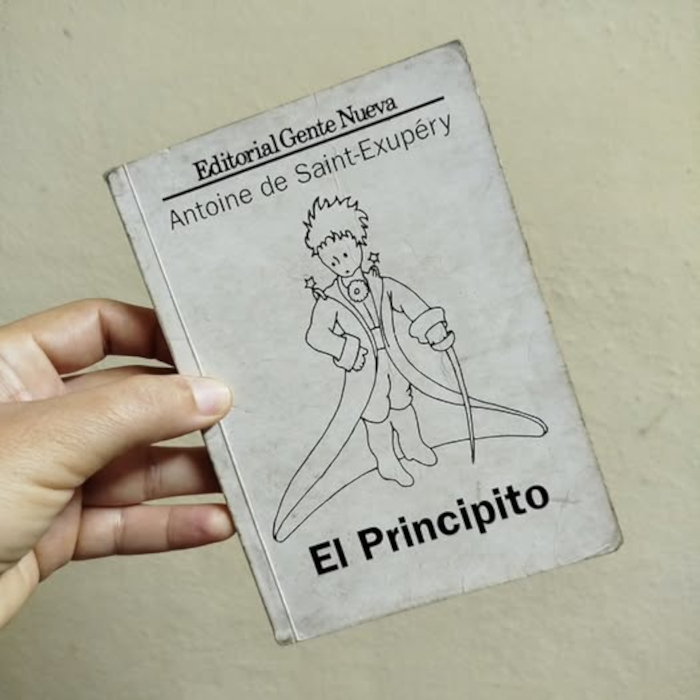
At a popular level, in the book fairs I remember covering as a reporter, The Little Prince always holds a special place. Even when it isn’t among the featured titles of the moment, it remains one of the most sought-after books, much like Heart by Edmondo De Amicis, which never seems to lose readers either. At home, we have two editions: one from 2001, with the cover shown in the photo, and a more recent one from 2019, both published by Gente Nueva. Something caught my attention recently: a Cuban booktuber shared a list of what he considered the ten greatest books of all time, and The Little Prince wasn’t included. In the comments, people protested in disbelief: “How is it possible that it’s not there?” That small debate confirms that, as the years go by, The Little Prince remains a reference point for adults and children alike—a book that crosses generations and geographies.
As we moved forward with the reading, we were reminded that it’s not just about reading for reading’s sake: every page, every character, every drawing is training for life, for reason, and for feeling. Saint-Exupéry’s language is simple yet profound, poetic and reflective; it invites us to think and to feel at the same time, to discover that what is essential is invisible to the eye, that friendship, care, and love are learned day by day.
One part we adore is when he tends his rose and learns that what matters most is what the heart feels. We also love the episode with the fox, who teaches the Little Prince that to tame someone means to create bonds and to take responsibility for those we love.
When school assigns readings and tasks like The Little Prince, the effect is double: positive and challenging. Positive, because it allows children to approach literature reflectively, to learn about values, language, and critical thinking. Challenging, because part of the responsibility for learning falls on the family. That can create tension, but it also lets us observe how children apply what they already know and remember, integrating memory, imagination, and analysis.
In short, the situation reflects the challenges of school and formal education, but also the opportunity to strengthen bonds and skills at home.
As a mother, I can’t help thinking about school—about its gaps and the responsibility that falls on us as parents. But I also think about how valuable these moments are, about how a single reading can open a space for curiosity, questions, imagination, and reflection. Because reading The Little Prince is really a conversation about life, about adults who lose sight of what truly matters, about friendship and responsibility toward those we love.
As she keeps reading, studying the drawings and planning her own, I’m reminded that every page is a small victory: against the rush of the world, against lack of time, against superficiality. A victory for imagination, for the heart, and for the bond created when a book—though brief—manages to open entire worlds.
I almost forgot. Last night, my daughter finished the book. Early this morning, while I was sharing ideas for this piece, she proudly reminded me—like a personal record—that she read all 126 pages in about two hours. Luckily, the lamp’s battery lasted. Now all that’s left is for her to process it all to answer the questions: from facts about the author, to anecdotes from the book, its moral lesson, and a free interpretation through drawings.
And most importantly, for both of us: there is no tragic ending here. We keep walking together, learning to protect, to love, to imagine, and to adjust our steps, while the little princes in our lives teach us every day how to be more human.
Translated by Linet Acuña Quilez